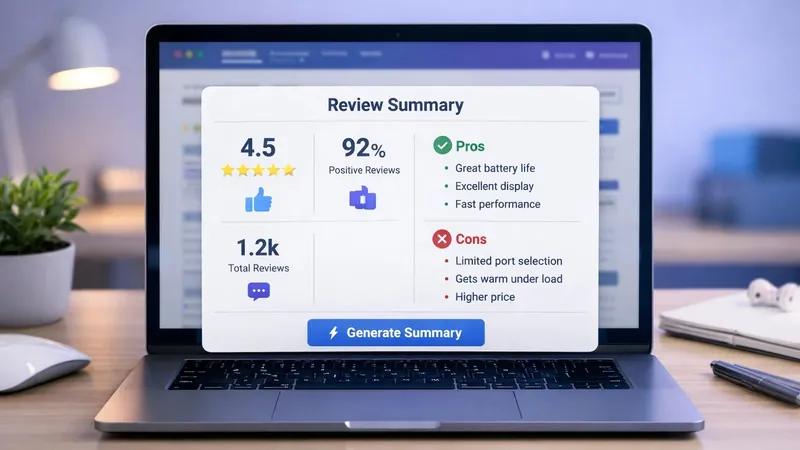
What the G2 review extractor does
Collecting reviews from G2 by hand is slow, dull work. You open a product page, scroll, copy a review, open the next product in a new tab, scroll again. Twenty products in, you have a messy spreadsheet and an hour gone.
I built a G2 review extractor so I would stop doing that. It is a browser script — a small piece of code that runs inside your own browser, on a page you already have open — and when it loads, it adds a button to the G2 page. You click the button and it pulls the reviews into one panel you can scroll through.
What you get back
The panel collects reviews across different products and lays out, for each one:
- The star rating
- The reviewer name
- The date the review was posted
- What the reviewer said they liked
- What the reviewer said they disliked
Everything sits in one scrollable view on the page you are already on. No tab switching, no copy-paste, no second window to keep alive.
What it does not do
It is a reader, not a database. This version renders the reviews on screen so you can read them fast — it does not write a file on its own. Saving to CSV is an add-on rather than something it does out of the box, and I cover that further down.
It also does not log in for you. It runs inside whatever session you already have open in your browser, which is the whole point of building it this way.
Why I built it as a Tampermonkey userscript
Tampermonkey is a browser extension that runs small scripts on pages you visit. A script written for it is called a userscript. You install the extension once, paste in a script, and it wakes up whenever you land on a page it is written for. The <a href="https://www.tampermonkey.net/" target="_blank" rel="noopener noreferrer">official Tampermonkey extension and documentation</a> covers the supported browsers.
That approach beats a hosted scraper here for four reasons:
- No setup. No server, no Python environment, no scheduler to configure.
- It runs in your browser. The page renders the way it renders for you.
- It uses your normal session. No separate login, no cookie handling, no headless browser pretending to be you.
- Results appear on the page. You read them where you already are.
For a job like this — read a page you are already looking at, pull out structured bits, show them back — a userscript is the right size of tool. When a job needs scheduling, storage, or an API on the other end, I reach for Python and Playwright instead. I've written more about that split across my posts on scraping and browser automation.
Installing it
- Add the Tampermonkey extension to Chrome, Edge, or Firefox.
- Open the Tampermonkey dashboard and create a new script.
- Paste the script in and save it.
- Visit a G2 product page. The button appears on the page.
Watch it run
The video below shows the whole thing end to end: the button appearing, one click, and the reviews filling the panel. It is worth watching before you install anything, so you know what you are getting.
Using the output for G2 competitor research
Speed is the obvious win. The more useful one is that reading fifty reviews together shows you patterns you would never spot reading them one at a time.
Laid out side by side, you can see:
- What users are most frustrated about
- Which tools are rated poorly, and on what
- Which complaints repeat across products in the same category
That is genuinely useful if you are doing market research, sizing up competitors, or building a service around a gap you keep seeing.
Reading the cons column to find prospects
Here is the part I actually use it for.
Look at the "Cons" in reviews. When people complain about repetitive work, manual copying, or exporting data by hand, that is a job someone would pay to have automated. The complaint is the brief.
It also gives you an opening that isn't a cold pitch:
"I noticed people are struggling with this — I can help automate it."
That lands better than a generic message, because it starts from something the person already said out loud in public.
Where scripts that scrape G2 reviews tend to break
Any script that reads a live web page depends on that page staying the same. Mine is no exception, and it is worth knowing where the cracks appear before you rely on it.
The page structure changes
The script finds reviews by looking for specific elements in the page's structure — the MDN introduction to the Document Object Model explains what that means in practice. When a site redesigns or renames a class, the script stops finding anything and the panel comes back empty. The fix is usually small: update which elements it looks for. But it is a fix, and it will need doing again eventually.
Content that loads as you scroll
Review sections often load in batches as you scroll rather than all at once. If a script runs before that content exists, it reads whatever is on screen and misses the rest. Scroll the section fully before clicking, and check the count looks right.
Taking it further
The version I use is deliberately simple. It is a reasonable starting point for:
- Saving the results to a file instead of reading them on screen
- Filtering to show only low-rated reviews
- Running the same idea for competitive research across a category
- Growing it into a proper scraper with storage behind it
That last step is where a userscript stops being the right tool and a Python and Playwright build takes over — usually with the results landing in a Google Sheet, an Airtable base, or a PostgreSQL database rather than a browser panel.
Terms of service and robots.txt
I build the technical side. Whether you are allowed to collect data from a given site is a separate question, and it is yours to answer.
Before running any extraction script, read the site's own terms — G2 publishes its terms of use — and check what its robots.txt file permits. Google's documentation on how robots.txt works is a clear explanation if the format is new to you. I will tell you what is technically possible. I will not tell you it is permitted, because that call depends on the site, your account, and what you plan to do with the data.
If you would rather have one built
Not everyone wants to install an extension and maintain a script. If you have a site you need data out of and no interest in the plumbing, that is the work I do.
I build custom scrapers and automation to order — browser automation and scraping services I offer covers the six areas I work in, from userscripts like this one through to scheduled Python pipelines with the data cleaned and loaded into a database. If you want to talk about a specific job